Food Myths
Older eggs peel more easily, and the usual explanation is shaky
Cooks have noticed for generations that a very fresh boiled egg fights back. The effect is real and repeatable, while the tidy chemical story behind it is less settled than it sounds.

These are listed in the order worth acting on, which with peeling boiled eggs is not the order they are usually presented in.
What matters most
- Eggs a week or more old generally peel more cleanly than very fresh ones.
- The standard explanation involves rising internal pH as carbon dioxide escapes.
- Cooking method affects the result at least as much as age does.
The observation
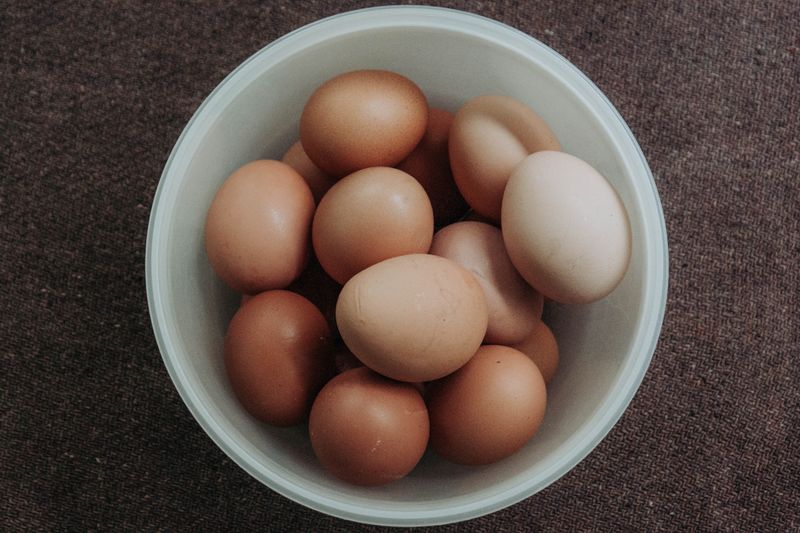
An egg laid that morning and boiled the same day will often shed its shell in fragments, taking the white with it and leaving a cratered surface. The same eggs left in the fridge for a week and cooked identically usually peel in one or two clean pieces. This is one of the more reliable pieces of kitchen folklore, in that it survives being tested by people who did not expect it to.
Anyone with access to genuinely fresh eggs can run the comparison over a fortnight with no equipment beyond a pan and a clock. The observation is solid, which is worth separating from the explanation, because those two things have very different levels of support.
The standard explanation
The usual account is that a fresh egg contains dissolved carbon dioxide, which gradually escapes through the porous shell as the egg ages. Losing that carbon dioxide raises the pH of the white, and the story runs that the more alkaline white adheres less strongly to the inner membrane.
Where the story actually begins, supporting this, some cooks add a small quantity of an alkaline ingredient to the cooking water and report easier peeling. The air cell inside the shell also grows as the egg loses moisture, which may simply give the white somewhere to pull away to. Both mechanisms are plausible and they are not exclusive, but the relative contribution of each is not well pinned down.
Why the explanation is not settled
Kitchen tests of the alkalinity route give mixed results, with some careful comparisons finding a clear effect and others finding very little. Confounding factors are difficult to control at home, since egg size, storage temperature, breed and diet all vary between batches. The membrane structure itself changes with age, which offers a mechanical explanation that has nothing to do with acidity at all.
Checked against the record, where a food-science question has several proposed mechanisms and no decisive test, the honest answer is that the cause is not established. None of this affects the practical advice, which is one of the reasons nobody has been in a hurry to settle it.
What the cooking method does
Starting eggs in already boiling water, or steaming them, gives a noticeably better result than starting them in cold water and heating slowly. The likely reason is that rapid heating sets the outer layer of white quickly and shrinks it away from the membrane before it can bond. Plunging cooked eggs into cold water afterwards contracts the contents further and is widely reported to help.
Where the story actually begins, cracking the shell and letting cold water work under the membrane before peeling makes the biggest single difference for most people. These interventions are larger in effect than egg age, which is worth knowing if you cannot control how fresh your eggs are.
How eggs age
The shell is porous, so an egg continuously loses water vapour and carbon dioxide and takes in air, which is why the air cell grows. The white also thins over time as its protein structure changes, which is why an older egg spreads more in the pan when fried.
Trace it back and this is why a very old egg floats in water: the air cell has grown enough to change the overall density. Refrigeration slows all of these processes considerably, which is one reason egg storage practice varies so much between countries. Where eggs are washed before sale the protective coating is removed, which speeds up the exchange through the shell.
A claim being badly sourced does not make its opposite true.
The general lesson
A piece of kitchen lore can be entirely correct as an observation while the explanation attached to it is guesswork with a chemical vocabulary. Explanations are more satisfying than observations, so they get attached quickly and then repeated as though they were the finding. It is worth learning to hold the two apart, because the observation may be robust while the mechanism gets revised repeatedly.
In this case the practical instruction has been stable for generations and the theory has changed more than once. Cooking is full of these, and noticing them is more useful than picking a side.
Everything above, in order of what to do first
- The observation. An egg laid that morning and boiled the same day will often shed its shell in fragments, taking the white with it and leaving a cratered surface.
- The standard explanation. The usual account is that a fresh egg contains dissolved carbon dioxide, which gradually escapes through the porous shell as the egg ages.
- Why the explanation is not settled. Kitchen tests of the alkalinity route give mixed results, with some careful comparisons finding a clear effect and others finding very little.
- What the cooking method does. Starting eggs in already boiling water, or steaming them, gives a noticeably better result than starting them in cold water and heating slowly.
- How eggs age. The shell is porous, so an egg continuously loses water vapour and carbon dioxide and takes in air, which is why the air cell grows.
- The general lesson. A piece of kitchen lore can be entirely correct as an observation while the explanation attached to it is guesswork with a chemical vocabulary.
The takeaway
The observation has been reliable for generations. The explanation has been rewritten several times, and still is not finished.
The satisfying version of a story is the one that travels, which is the whole problem.
Questions readers ask
How old should the eggs be?
A week or so of refrigerated storage is usually enough to see the difference. Older still generally continues to help, within reason.
Does adding anything to the water help?
Reports are mixed. Cooking method and rapid cooling appear to matter more consistently than anything added to the pan.