Food Myths
The alcohol does not all cook off, and the numbers are not close
Retention depends on method and time, and a splash of wine stirred through at the end keeps most of what you added. Flaming a pan keeps more than almost anything.
There is a settled way of talking about alcohol retention in cooking. It is worth asking how much of it survives contact with the detail.
The argument in brief
- Alcohol and water form a mixture that does not separate cleanly by boiling.
- Retention tables compiled for food databases show wide variation by method.
- Long simmering with a wide pan removes the most; brief additions remove the least.
Why the assumption seems reasonable
Ethanol boils at a lower temperature than water, so it is natural to assume it leaves first and leaves completely. That reasoning would hold for a pure liquid, but a sauce is a mixture, and mixtures do not obey the simple version.
Alcohol and water form a combination whose vapour carries both substances together, which is why distilling requires a column rather than a saucepan. A domestic pan is about the least efficient separation apparatus imaginable, having no reflux, no fractionation and no temperature control. So the intuition is sound chemistry applied to the wrong situation, which is the most forgivable kind of error.
What the measurements show
Retention factors compiled for food composition databases record how much alcohol survives various cooking methods. The pattern is consistent, in that longer cooking times and larger exposed surfaces remove more, while brief exposure removes very little.
A dish simmered for several hours in an open pan retains only a small fraction, but it does not reach zero. A sauce finished with a splash of spirit and served immediately retains most of what went in. The variation across methods is large enough that a single figure for cooking off is meaningless.
Flaming keeps more than you think
Setting light to a pan produces a dramatic effect, and the flame consumes only the vapour above the surface. The burn is over in seconds, which is nowhere near long enough for the liquid beneath to lose much of its content. Measurements of flamed dishes consistently show high retention, often higher than gentle simmering for the same total time.
Tested properly, the theatre and the chemistry point in opposite directions here, which is why the technique is so misleading. It is worth doing for the caramelisation the burst of heat produces, not for removing anything.
What actually drives it off
Three things matter, namely time on the heat, the surface area available for evaporation, and whether the pan is covered. A wide shallow pan left uncovered for an hour removes far more than a deep covered pot for the same hour. Adding the alcohol early, so it cooks through the whole process, does far more than any amount of vigorous boiling at the end.
Stirring helps by bringing lower liquid to the surface, since evaporation only happens at the interface with the air.
None of this is difficult, but it requires treating the alcohol as an ingredient to be reduced rather than a step to be completed.
Why cookbooks kept saying it
The claim was convenient, allowing recipes to include wine and spirits without complicating who could eat the dish. It also matched what cooks could observe, since the smell of alcohol does fade well before the alcohol itself is gone.
Trace it back and smell is a poor instrument for this, because aroma compounds behave differently from the ethanol in the liquid. Once printed in enough books, the claim became something nobody thought to question or measure. Retention data only entered general awareness when food composition databases were compiled for other purposes entirely.
Where the earliest trace is a newspaper anecdote, treat the whole chain with suspicion.
Cooking with it deliberately
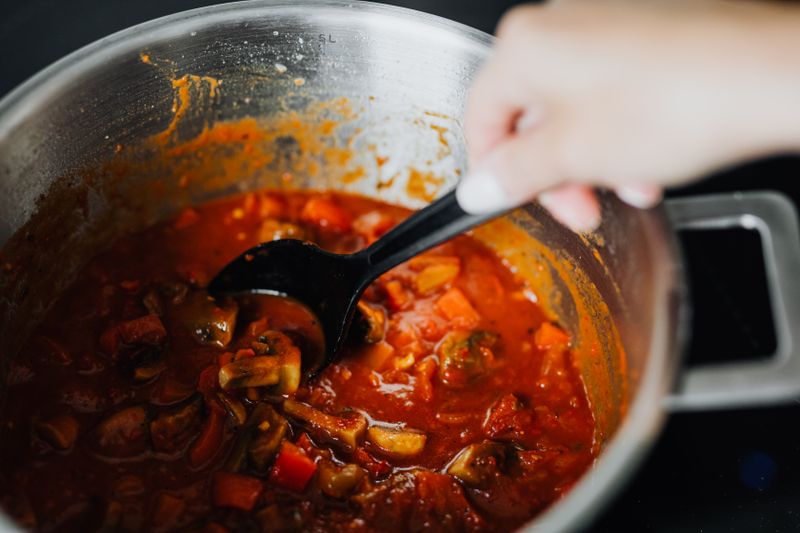
Alcohol does useful work in a sauce beyond flavour, dissolving aroma compounds that neither water nor fat will carry. That is why a splash of wine can change how a tomato sauce smells out of proportion to the quantity involved.
Checked against the record, it also affects texture in batters and doughs, evaporating faster than water and altering how a crust sets. If you want the effect without much of the alcohol, add early and reduce for a long time in a wide pan. If you want the aroma at its brightest, add at the end and accept that most of it is still there.
The takeaway
A pan is not a still, and a mixture of alcohol and water leaves together rather than in order.
The satisfying version of a story is the one that travels, which is the whole problem.
Questions readers ask
Does flambéing remove the alcohol?
Barely. The flame burns vapour above the surface for a few seconds, which has little effect on the liquid underneath.
What removes the most?
Long, uncovered simmering in a wide pan. Time and exposed surface area matter far more than how vigorously the pan boils.