History Myths
White marble is what survived, not what the sculptors wanted
Greek and Roman statues were painted in strong colours, and traces have been recorded since the nineteenth century. The taste for bare stone came later, and some collections scrubbed the evidence off.

Comparisons of the colour of classical sculpture usually pick a winner. This one picks the circumstances, which is more useful.
The difference in one place
- Pigment traces survive on many classical sculptures and can be detected by several methods.
- The preference for unpainted marble developed long after antiquity.
- Some cleaning practices in past centuries removed surviving colour.
How the colour is detected
Raking light across a marble surface at a shallow angle reveals differences in weathering where paint once protected the stone, producing a faint ghost of the original pattern. Ultraviolet illumination makes some organic binders and pigments fluoresce, showing designs that are entirely invisible under ordinary light.
Chemical and spectroscopic analysis identifies specific mineral pigments in surviving traces, including compounds used for reds, blues and greens. Fragments recovered from burial, where they were shielded from rain and handling, sometimes retain visible colour without needing any technique at all. These methods agree with one another and with ancient written descriptions, which is why the general conclusion is not seriously contested.
What ancient writers said
Greek and Roman authors refer to the painting of statues as an ordinary part of making them, and name craftsmen who specialised in exactly that work. There are passages discussing which painter had coloured which sculptor's figures, treating the two trades as collaborators rather than as separate art forms.
Somewhere in the retelling, temple accounts and inscriptions record payments for pigments, which is the sort of dull financial evidence that is extremely hard to argue away. None of this was hidden or forgotten in antiquity, and it would have puzzled a Greek visitor to be told the statues were meant to be white. The information was always sitting in the texts, which makes the persistence of the white ideal a question about taste rather than about evidence.
How the white ideal formed
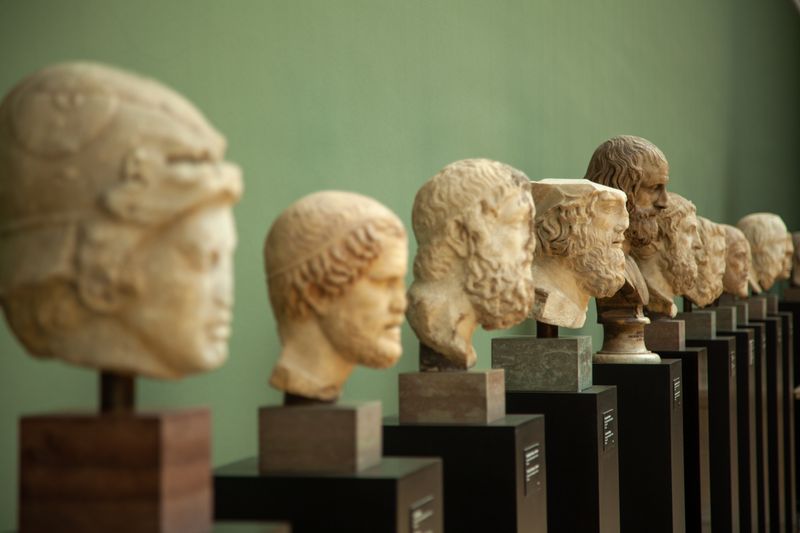
Sculptures recovered during the Renaissance and afterwards had spent centuries in the ground or in the weather, and had lost most or all of their surface colour. Artists and patrons formed their sense of classical beauty from precisely those bleached survivors, and produced new work designed to match them. Influential eighteenth-century writing on ancient art praised the purity and restraint of white stone, giving an accident of survival a philosophical justification.
Trace it back and once whiteness had been theorised as a virtue, reports of paint were treated as embarrassing exceptions or as evidence of provincial bad taste. Several nineteenth-century scholars who reported pigment traces found their observations dismissed rather than tested by their colleagues.
The cleaning problem
Traces of surface colour are fragile, sitting in the outermost fraction of a millimetre of stone, and any aggressive cleaning removes them permanently. Some celebrated collections were cleaned in past centuries with abrasives and chemicals, in the belief that dirt was being removed and a true surface restored.
Checked against the record, where records of those treatments survive, they sometimes describe removing a yellow or brown discolouration that may in part have been the remains of an original finish. This is not really a story of vandalism so much as of curators applying the aesthetic standard of their own moment with entirely good intentions.
It does mean that the objects most familiar to the public are among the least likely to retain any evidence at all.
Why the reconstructions look strange
Colour reconstructions displayed in recent decades often strike viewers as garish, and that reaction is worth taking seriously rather than waving away. The pigments identified tell you which mineral was used but not how it was mixed, layered, glazed or toned down by the painter who applied it.
Reconstructions therefore tend to show flat blocks of saturated colour where the original may have carried shading, transparency and a great deal of fine detail. Specialists describe these models as hypotheses meant to provoke argument rather than as finished pictures of what any particular statue looked like. The core claim that the statues were painted is secure, while the precise appearance of any individual figure remains genuinely uncertain.
Some of these are genuinely unsettled, and saying so is more honest than picking a side.
What changes if you accept it
Painted sculpture belongs to a different visual world, much closer to the interiors of temples and the painted architecture that surrounded it. Details that look inexplicably crude in bare stone, such as shallow carving of hair or eyes, make sense as surfaces intended to be finished in paint. The blank eyes of classical portraits, so often described as serene and otherworldly, were frequently painted with irises and lashes.
Checked against the record, recognising this does not diminish the sculpture, and mostly makes the surviving carving look more sophisticated rather than less. The white ideal turns out to be a modern preference that got projected backwards onto people who plainly did not share it.
Side by side
| Consideration | What it means in practice |
|---|---|
| How the colour is detected | Pigment traces survive on many classical sculptures and can be detected by several methods. |
| What ancient writers said | The preference for unpainted marble developed long after antiquity. |
| How the white ideal formed | Some cleaning practices in past centuries removed surviving colour. |
The takeaway
We built an entire aesthetic on the fact that paint does not survive a thousand years in the ground.
Ask who gained from the claim being repeated. That usually explains the rest.
Questions readers ask
How certain is this?
Very. Pigment traces, written sources and financial records all agree. What remains uncertain is the exact appearance of any individual statue.
Why do reconstructions look so bright?
They show identified pigments as flat colour, because the layering, glazing and shading a painter would have applied leaves far less evidence behind.