History Myths
A vomitorium was a doorway, and the banqueting room never existed
The Latin word names the passages that spill a crowd out of an amphitheatre. The dining-room version was invented by English writers long afterwards, though Roman satirists did complain about purging.

There is a settled way of talking about the Roman vomitorium. It is worth asking how much of it survives contact with the detail.
The argument in brief
- The word describes exit passages in Roman entertainment buildings.
- The dining-room sense appears only in much later English writing.
- Roman moralists did describe purging at banquets, but never a room for it.
What the word describes
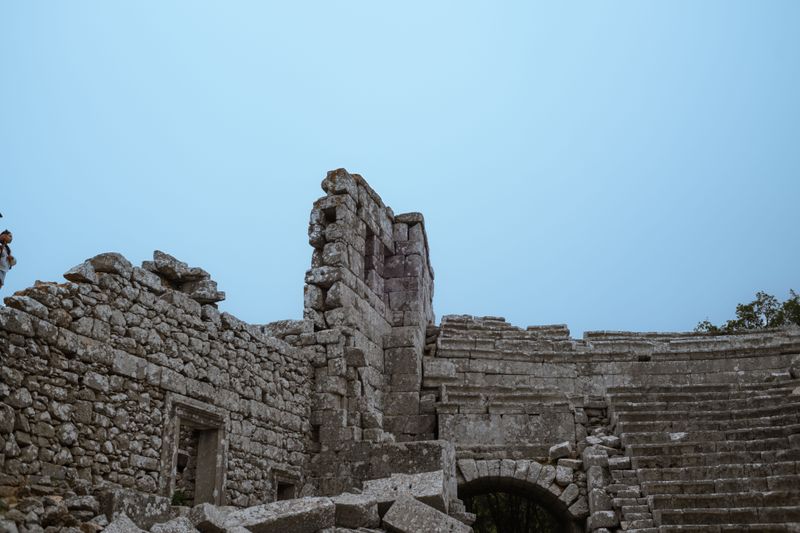
The Latin term comes from the verb meaning to spew or discharge, and it was applied to the passages through which a building emptied its audience. A large amphitheatre had many such openings arranged around the seating so that spectators could reach an exit without crossing the whole structure. The image is of the building disgorging its crowd, which is vivid architectural vocabulary rather than a description of anybody being unwell.
The same word appears in surviving Roman writing about buildings, where the surrounding context makes the meaning entirely unambiguous. Modern stadium design uses the identical principle and occasionally the identical word, which is a small monument to the Romans getting crowd flow right.
The building problem it solved
Emptying tens of thousands of people out of a stone bowl is a serious engineering task, and a slow exit is a genuinely dangerous one. Roman designers separated the flows by seating block, giving each section its own stairways and openings so that streams of people did not merge and stall. Numbered entrances corresponding to numbered tokens appear in the archaeology, which suggests spectators were directed along a specific route in and out.
The result was a building that could be cleared quickly, and the surviving structures still show the logic clearly to anyone walking through them. That practical achievement is considerably more interesting than the invented dining room, and almost nobody ever mentions it.
Where the false sense came from
The dining-room meaning does not occur in Latin and appears in English only in the modern period, where it spread quickly among writers describing Roman decadence. A well-known novelist used the word in that sense in the early twentieth century, which gave it literary respectability and an enormous amount of circulation.
Dictionaries now record the erroneous sense because dictionaries record usage, which sometimes creates an impression that the error has been officially authorised. Once a word looks as though it explains a habit people already believe in, it stops being examined and starts being treated as evidence for the habit. The chain runs from a real architectural term to an imaginary room, entirely inside English and entirely after the fact.
What Roman writers actually said
Roman moralists did describe wealthy diners vomiting in order to carry on eating, and treated it as a symbol of a society that had lost its discipline. Those passages are satire and philosophy rather than reportage, and their purpose is to condemn rather than to document what typically happened at dinner. Medical writing of the period also discusses induced vomiting as a treatment, which is a different context with entirely different assumptions behind it.
Nothing in either body of writing describes a dedicated room, and no archaeological candidate for such a room has ever been identified anywhere.
The honest summary is that some Romans probably did this some of the time, and that no building was ever set aside for the purpose.
Why decadence stories travel
Rome functions in the popular imagination as a warning about excess, so any detail that fits the warning gets accepted without much scrutiny. A purpose-built room is a far better story than an occasional habit, because architecture implies routine, planning and institutional approval. The same impulse produces exaggerated claims about several other Roman practices, most of which rest on the same handful of satirical passages.
Satirists get quoted as witnesses precisely because they are entertaining, which is the worst possible reason to treat anyone as a source. Reading a satirist as a documentary account is one of the commonest ways in which ancient history gets quietly distorted.
Where the earliest trace is a newspaper anecdote, treat the whole chain with suspicion.
The version worth repeating
The word is real, the buildings are real, and you can still walk through the passages it names in several surviving amphitheatres. The room is not real, and the English sense that invented it is younger than the railway by a comfortable margin.
The habit was real enough to be worth condemning, which is not the same as being usual, and the sources are hostile witnesses throughout. Keeping those three statements separate is most of what historical method consists of when it is actually being practised. It also leaves you with a better fact than the one you started with, which is the usual reward for checking.
The takeaway
The building did the vomiting. It spewed out a crowd, which is a much better use of the word.
The satisfying version of a story is the one that travels, which is the whole problem.
Questions readers ask
Did Romans vomit at banquets?
Some appear to have done, according to writers who disapproved. Those writers were satirists and philosophers, not chroniclers, and they describe a habit rather than a room.
Is the dining-room meaning in dictionaries?
Some record it, because dictionaries document how words are used. That is a record of the error rather than an endorsement of it.
Also by Farah Dastur
- The Great Wall was declared visible from the Moon before anyone went thereScience Myths
- Your bathroom drain is far too small to notice the Earth turningScience Myths
- Split-brain surgery was real, the creative-versus-logical personality was notScience Myths
- Viking helmets got their horns from a costume department in 1876History Myths