Everyday Misconceptions
Bats can see, and an eighteenth-century experiment made things worse
Every bat has functional eyes, and many rely on them heavily. A brilliant set of experiments in the 1790s showed blinded bats navigating perfectly, which everyone drew the wrong lesson from.

Both approaches to the idea that bats are blind work. What differs is what they cost you, and the cost is what this sets out.
The difference in one place
- All bat species have functional eyes and none is blind.
- Fruit bats rely largely on vision and smell rather than echolocation.
- Eighteenth-century experiments showed navigation without sight and were misread.
What bats can actually see
Every known bat species has functional eyes, and vision is used for orientation, for spotting landmarks and for detecting light levels. Species that feed on fruit and nectar generally have large eyes and good vision, and most of them do not echolocate at all. Even species that hunt insects by sound use vision for long-range navigation, since echolocation has a limited useful range.
Some species can see into the ultraviolet, which may help them locate flowers that reflect in that range. The claim that bats are blind is not an exaggeration of a partial truth but simply wrong about every species.
The experiments that started it
In the 1790s an Italian naturalist ran a series of experiments in which bats with their sight removed continued to fly and avoid obstacles. The same animals became disoriented when their ears were blocked, which was the crucial and overlooked result.
Tested properly, the correct conclusion, that they were navigating by hearing, was proposed at the time and largely rejected. The result that spread was the memorable half, namely that a bat does not need its eyes. That is a very different claim from saying a bat has no eyes, and the distinction was lost within a generation.
How echolocation actually works
Insect-hunting bats emit rapid high-frequency calls and interpret the returning echoes to build a picture of their surroundings. The system provides remarkable detail at short range, sufficient to catch a moving insect in complete darkness.
The primary source says otherwise: it is energetically expensive and short-ranged, which is why vision remains useful for anything beyond a few metres. Different species use different call structures suited to open air, cluttered vegetation or water surfaces. Confirmation of the mechanism came in the twentieth century with equipment capable of detecting the ultrasonic calls.
Where the proverb came from
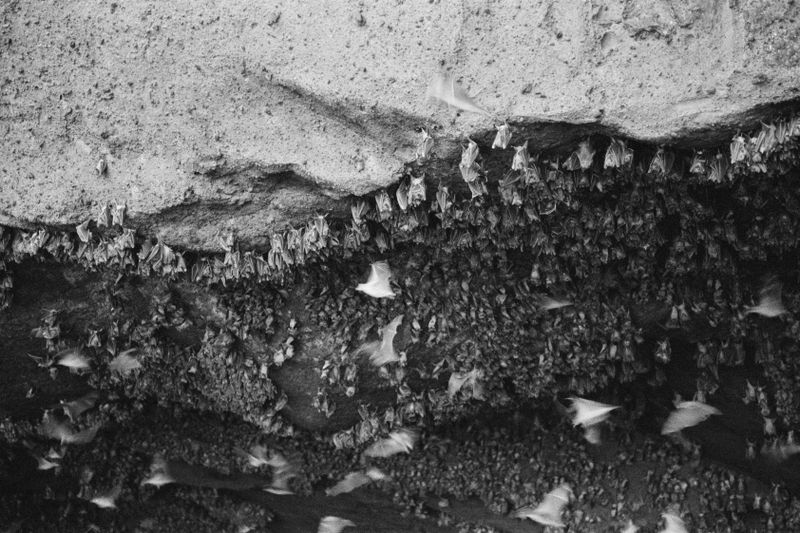
The expression comparing something to a blind bat is recorded in English centuries before anything was known about echolocation. It appears to derive from the erratic appearance of bat flight at dusk, which reads as an animal that cannot see where it is going. Bats also emerge at low light levels when human vision is at its worst, which invites the comparison.
Somewhere in the retelling, once the phrase existed, the eighteenth-century experiments seemed to confirm it rather than contradict it.
A proverb and a misread experiment reinforcing each other is a strong combination to argue against.
Why the flight looks erratic
Bats hunting insects are pursuing targets that jink unpredictably, and the flight path reflects the prey rather than confusion. Their wing membranes allow far tighter turns than a bird can manage, so the changes of direction are sharper than we expect.
The primary source says otherwise: some moths have evolved to detect bat calls and take evasive action, which makes the chase more erratic still. A few moth species jam the calls, which is a genuine acoustic arms race running above our heads every summer evening. What looks like blundering is a high-speed pursuit conducted with equipment we cannot perceive.
Where the earliest trace is a newspaper anecdote, treat the whole chain with suspicion.
Correcting it without overcorrecting
The accurate statement is that bats see well and that many also navigate by sound, using both according to circumstances. Saying that all bats echolocate would be its own error, since a large group of species does not. Saying that vision is unimportant to insect-hunting bats would also overshoot, since they use it for orientation.
Checked against the record, the general lesson is that animals usually combine senses rather than relying on one, which is true of us as well. A myth corrected into a different simplification has not really been corrected at all.
Side by side
| Consideration | What it means in practice |
|---|---|
| What bats can actually see | All bat species have functional eyes and none is blind. |
| The experiments that started it | Fruit bats rely largely on vision and smell rather than echolocation. |
| How echolocation actually works | Eighteenth-century experiments showed navigation without sight and were misread. |
The takeaway
The experiment proved they navigate by ear, and everybody remembered only that the eyes had been removed.
Ask who gained from the claim being repeated. That usually explains the rest.
Questions readers ask
Do all bats echolocate?
No. Many fruit and nectar-feeding species rely on vision and smell, and a large group has no echolocation at all.
Why do they fly so erratically?
They are chasing insects that change direction constantly, and their wings allow far tighter turns than a bird's.
Also by Anjali Sundaram
- The tongue map was a graph that lost its labelsScience Myths
- Nobody has ever found the source of the ten per cent brain claimScience Myths
- Deoxygenated blood is dark red and your veins are an optical trickScience Myths
- Earth is closest to the Sun in January, which is awkward for the usual explanationScience Myths