Science Myths
The seven-fold limit on paper is real, and a schoolgirl broke it with algebra
The claim that no sheet can be folded more than seven times circulated for decades as a fixed fact. A student worked out what actually stops you, and then folded something twelve times.

This is written to be used rather than admired. Each section below is a decision about the limit on folding paper, and each one has a default.
Before you start
- Each fold doubles the thickness while halving the usable length.
- Material is consumed by the curve at the fold, not just by the flat layers.
- A student derived a formula for the length required and then demonstrated twelve folds.
The claim as it circulated
For most of the twentieth century the statement that a sheet of paper cannot be folded in half more than seven times was repeated as a settled fact. It appeared in puzzle books and classroom demonstrations, usually with the invitation to try it, which produces convincing failure within about a minute.
The demonstration works because a standard sheet really does become impossible to fold at around seven, so everyone who tests it confirms the claim. What almost nobody did was ask which property of the paper was doing the stopping, or whether the limit was a number or a relationship. A claim that everyone verifies and nobody explains is one of the most stable kinds of misconception there is.
Why it gets hard so fast
Every fold doubles the number of layers, so after ten folds a single sheet has become a stack of more than a thousand. The same fold halves the area, which means the stack is getting rapidly thicker while the thing you are trying to bend gets rapidly smaller.
Somewhere in the retelling, thickness grows exponentially while the available length shrinks exponentially, and two exponentials moving in opposite directions end an argument quickly. Force is not the limiting factor in the way people assume, because a hydraulic press does not buy you very many additional folds. The limit is geometric rather than muscular, which is why brute strength has so little to offer.
What the fold itself costs
The insight that unlocked the problem is that paper cannot bend to a sharp corner, so each fold contains a curved section of material. That curve consumes length in proportion to the thickness of the stack, and the stack is doubling every time.
The layers on the inside of the curve must therefore be shorter than the layers on the outside, and something has to give. Once the length lost to the curves exceeds the length remaining, the next fold is not difficult but impossible. This reframes the question from how strong are you to how long is your sheet relative to its thickness.
The formula and the demonstration
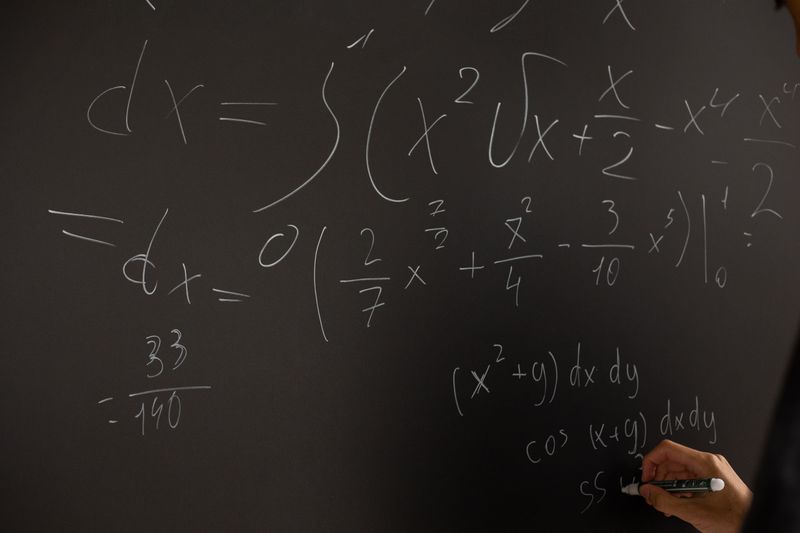
In the early 2000s an American secondary school student working on a mathematics challenge derived an equation relating the required length to the thickness and the number of folds. The equation shows that the length needed grows extremely rapidly, which is why ordinary sheets stop where they do.
Trace it back and she then obtained a very long single roll of thin paper and folded it repeatedly in one direction, reaching twelve folds. Folding in a single direction rather than alternating changes the geometry and is the reason a long narrow strip beats a large square.
The demonstration and the derivation together are far more satisfying than either would be alone, because the number was predicted before it was achieved.
What later attempts showed
Groups using very long rolls of thin material in corridors and public spaces have pushed the count further, following the same single-direction approach. Each additional fold requires roughly four times the length, so improvements come slowly and require increasingly absurd amounts of material. Attempts using presses on ordinary sheets confirm the geometric account, since the stack simply refuses regardless of the force applied.
The results line up with what the formula predicts, which is the useful part rather than the record itself. A prediction that survives people actively trying to break it is worth considerably more than a number in a puzzle book.
Why the myth was so durable
It was easy to test, and every test appeared to confirm it, which is the ideal condition for a wrong claim to survive indefinitely. The number seven also feels like a fact rather than a coincidence, and specific numbers are far more memorable than relationships.
Somewhere in the retelling, nobody had an incentive to investigate, because the claim was harmless and the demonstration was entertaining. It took somebody treating a party trick as a problem in geometry to find that the limit depended on the paper rather than on folding as such. That is the whole shape of the story, and it is a better lesson than the fold count it produced.
The takeaway
The limit was never seven. It was a relationship between length and thickness, and nobody had bothered to write it down.
Believing it was ordinary. Continuing to is the avoidable part.
Questions readers ask
Can any paper be folded twelve times?
No. It requires an unusually long and thin sheet folded in a single direction. An ordinary square sheet stops at around six or seven.
Does more force help?
Very little. The obstacle is that the curve at each fold consumes length in proportion to a thickness that doubles every time.